
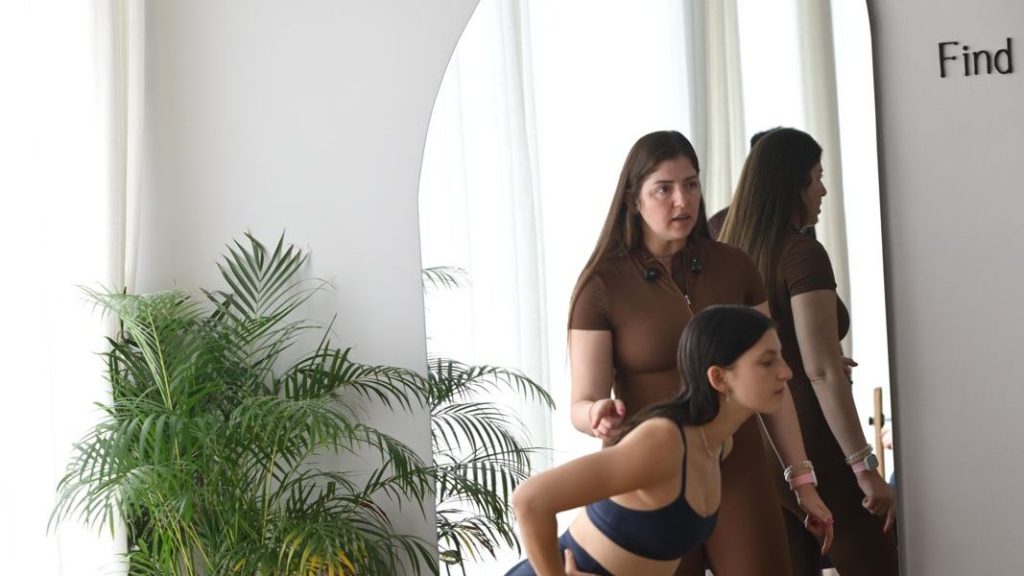
By Chen Leibovich, founder of Go Pilates Academy. Chen has taught Pilates for 10 years, ran two studios of her own, and built an NPCP Verified teacher training program with 700+ certified graduates in 30+ countries.
If you have decided to teach Pilates, the next question usually stops people in their tracks: mat vs reformer Pilates certification, which one should I do? They sound similar, but they lead to different classes, different studios and different hiring conversations. Picking the wrong one first can cost you months, or a second tuition bill.
We train instructors on both, and this question comes up on almost every advisor call. This guide compares what each certification teaches, where each one gets you hired, how many hours and how much money each takes, which one makes sense to do first, and when the Mat + Reformer combination is the smarter move.
The quick answer
- Mat Pilates certification teaches the foundational repertoire on the floor. It is shorter (often around 100 hours), lower cost, and the right base for nearly everyone. It gets you into gyms, community centers, corporate wellness and online classes.
- Reformer Pilates certification teaches the equipment that most boutique studios are built around. It takes more hours (often 150–300) and costs more, but it opens the door to reformer group classes and privates.
- Which first? Mat first, or both together. Mat teaches the principles every reformer exercise is built on.
- The most hireable option for most new instructors is Mat + Reformer, because you can say yes to almost any class a studio needs to fill.
Mat vs reformer Pilates certification: what each one teaches
Both certifications teach you to cue, correct and sequence a class. The difference is the tool you are teaching on and what that tool asks of you as a teacher.
A mat Pilates certification covers the classical mat repertoire (the Hundred, Roll Up, the abdominal series, side-lying work, extension) plus modifications and progressions, often with small props like the magic circle, bands and balls. Because there are no springs to support or challenge the body, mat is where you learn to really see movement and cue it with your words and your hands. Mat is also the heart of Pilates history: the National Pilates Certification Program (NPCP) bases its Mat exam on Return to Life, Joseph Pilates’ original mat work.
A reformer Pilates certification covers the reformer repertoire from beginner to advanced, plus everything the machine adds: spring settings, footbar and headrest positions, straps, the box, safety, and how to program a group class around equipment changes. You learn to use resistance to assist a beginner or challenge a strong client, and you learn to manage a room of moving carriages safely.
| Mat | Reformer | |
|---|---|---|
| Equipment | Mat and small props | Reformer (springs, straps, box, footbar) |
| Core skills | Foundational principles, observation, verbal cueing, modifications | Spring logic, set-ups and transitions, equipment safety, group flow |
| Typical hours | About 50–150 | About 150–300 |
| Typical US tuition | Roughly $500–$2,000 | Roughly $1,500–$4,000 |
| National exam | NPCP Mat exam (with a qualifying 100+ hour program) | No stand-alone NPCP reformer exam |
Where each certification gets you hired
This is the part most people underestimate. The certification you hold decides which job listings you can answer.
- Mat certification: big-box gyms and fitness centers, community and recreation centers, corporate wellness programs, physical therapy and wellness clinics that run group mat, retreats, and your own online or outdoor classes. You need almost no equipment to start teaching, which makes mat the easiest way to build your own clients.
- Reformer certification: boutique Pilates studios and reformer chains, which tend to schedule far more reformer classes than mat classes, plus private and semi-private sessions in equipped studios. Reformer classes usually cap at the number of machines in the room, and they tend to be priced higher, which is part of why studios value instructors who can teach them.
- Both: the widest range. A studio manager filling a schedule usually needs people who can cover the 6 a.m. reformer class and the Saturday mat class. Being able to say yes to both is often what gets you on the schedule faster.
Before you choose, look at the job listings and studio schedules where you actually live. If every studio near you is a reformer studio, a mat-only certification will limit you. If you want to teach at your gym or online, mat may be all you need for now.
Hours: what goes into each certification
“Hours” on a program page are never just class time. Most certifications combine coursework with observation, self-practice and practice teaching. Two well-known examples show how this adds up:
- Balanced Body Mat lists 134 total hours, including three 16-hour mat courses, a 16-hour Movement Principles course, 15 observation hours, 20 personal sessions and 35 student teaching hours.
- Balanced Body Mat & Reformer lists 332 total hours (anatomy not included), with 45 observation hours, 50 personal sessions and 125 student teaching hours.
- STOTT PILATES Intensive Mat-Plus lists 95 total training hours: 40 hours of instruction and supervised teaching, plus minimums of 10 observation, 30 physical review and 15 practice teaching hours.
Notice the pattern: adding the reformer roughly doubles or triples the hours, and most of that increase is supervised teaching, not lectures. That is a good thing. Teaching on equipment safely takes repetition with someone watching.
One note on the national exam: the NPCP Mat exam requires a Pilates mat teacher education of at least 100 hours, and its comprehensive exam requires a program of at least 450 hours covering all the major apparatus. There is no stand-alone reformer exam, so a reformer-only certificate is a school credential, not a national one.
Cost: what to expect for mat and reformer
Prices vary widely by brand, format and city, so treat these as general US ranges:
- Mat: roughly $500–$2,000.
- Reformer: roughly $1,500–$4,000.
- Mat + Reformer: roughly $2,500–$5,500, usually less than buying the two separately.
Reformer training costs more for practical reasons: more hours, more supervised teaching and access to equipment. When you compare programs, ask what is included. Anatomy, manuals, the final assessment, retakes and the hours you need on a reformer can all be extras. The NPCP Mat exam itself currently lists a $225 fee. Our full breakdown is in how much Pilates instructor certification costs.
Which Pilates certification first: mat or reformer?
For most people, my answer is mat first, or mat and reformer together. Here is why:
- Mat teaches the principles. Breath, core connection, spinal articulation and alignment are clearest without springs. Footwork, the Hundred and Short Spine on the reformer all make more sense once you have taught their mat versions.
- Mat makes you a better cuer. With no machine to do part of the work, you learn to use your words and eyes. That skill carries straight into reformer classes.
- It’s the faster, lower-cost start. You can begin teaching sooner and earn while you add equipment.
- It keeps the national exam open. A qualifying mat program makes you eligible for the NPCP Mat exam.
When does reformer-first make sense? If you already have a strong movement background (for example, you are a personal trainer, dancer or physical therapist), you take reformer classes regularly, and the studios hiring near you are all reformer studios. Even then, choose a reformer program that teaches the underlying principles, not just a list of exercises.
The Mat + Reformer combination: is it worth it?
If you plan to teach in studios, the combination is usually the best value. You learn each exercise on the mat and then on the machine, so the two halves reinforce each other instead of feeling like separate courses. You finish able to teach both class types, which makes you more useful to a studio schedule. And a combined program is usually cheaper than buying the two separately.
The trade-off is time. A combined program takes longer than mat alone, so it suits people who can commit a few months. If you need to start teaching quickly, or you are not sure Pilates teaching is for you, start with mat in a program where your hours carry over, and add reformer later without paying twice.
And if you know you want to work with private clients on every piece of equipment, look at a comprehensive program of 450 hours or more, which is the pathway to the NPCP comprehensive exam.
How Go Pilates Academy can help
We offer every route described above, built on The Flow Method™, our approach to seamless transitions and flow. Our NPCP Verified, PAA Approved program includes a 100-hour Mat track (eligible for the NPCP Mat exam), a 120-hour Reformer track (Go Pilates Academy certificate), a 200-hour Mat + Reformer teacher training (eligible for the NPCP Mat exam), and a 450-hour Comprehensive.
You can train live online, with coursework, 20 private mentoring sessions and guided teaching practice. You don’t need a reformer at home, because you teach our instructors on their equipment over video. Or you can train in person in small groups with one reformer per student. Anatomy, your training kit and the final assessment with retakes are included, payment plans are available on every track, and your hours carry over if you start with Mat and upgrade later. See current tuition on our pricing page, or book a free advisor call and we’ll help you choose honestly.
The 45-Minute Pilates Class Plan
A ready-to-teach mat class with cues and options, plus the structure and checklist we use to plan every class in minutes.
Frequently asked questions
Can I teach reformer classes with only a mat certification?
You shouldn’t, and most studios won’t hire you to. The reformer adds springs, moving parts and safety considerations that a mat program doesn’t cover. Add a reformer certification before teaching on the equipment.
Is a reformer Pilates certification harder than mat?
It is longer and has more to remember: set-ups, spring settings and transitions. Many trainees find mat harder to teach well, though, because there is no equipment to help the client. That’s exactly why mat is such good preparation.
Do I need a reformer at home to get certified on the reformer?
It depends on the program. Some online programs require studio access for practice hours. At Go Pilates Academy you don’t need one: you practice teaching our instructors on their reformers over live video.
Which certification pays more?
Pay depends more on your city, the studio and whether you teach privates than on the certificate itself. In practice, instructors who can teach both mat and reformer usually get more classes, which often matters more than the rate per class.
Ready to map out the whole path, from choosing a track to your first class? Read our guide on how to become a Pilates instructor.
Related guides
- How long it takes to become a Pilates instructor
- How much Pilates instructor certification costs
- The NPCP exam: a complete guide
Turn your love of Pilates into a career you can teach.
Live online with 1:1 mentoring, or in person in a small cohort. Same method, same mentors, same certificate.