
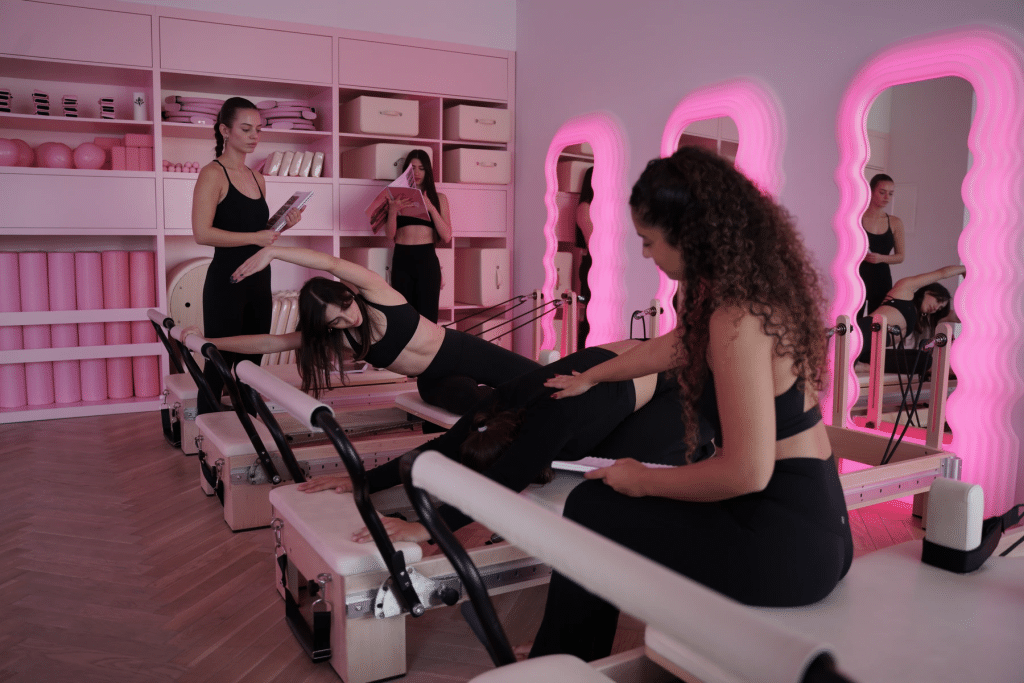
You love your Pilates classes. At some point, usually somewhere between the hundred and the roll-up, you start to wonder: could I teach this? The short answer is yes, and you don’t need a fitness degree or prior teaching experience to get there. What you need is the right training, enough real teaching practice, and a clear plan.
This guide walks you through exactly how to become a Pilates instructor in 2026: which certification to choose, online vs. in-person training, how long it takes, what it costs, and how to land your first teaching job.
The quick answer
- Decide what you want to teach: Mat, Reformer, or all apparatus (Comprehensive).
- Choose a format: online with live mentoring, or an in-person intensive.
- Pick a program that includes real, supervised teaching practice, not just videos.
- Complete the coursework, observation, self-practice and practice-teaching hours.
- Pass your program’s assessment and earn your certificate (and, if you want it, sit the national NPCP exam).
- Get insured, build your first class plans, and audition at studios.
Typical timeline: 2–4 months for Mat, 6–12 months for Comprehensive. Typical cost: roughly $600–$2,000 for Mat and $4,500–$7,500+ for Comprehensive in the US.
Do you need a certification to teach Pilates?
In the US, “Pilates instructor” is not a state-licensed profession, so there’s no law that says you must be certified. In practice, though, you do need one. Studios and gyms hire certified instructors, insurance providers ask for proof of training, and clients increasingly check credentials before booking. More importantly, a good certification is what teaches you to keep real bodies safe: injuries, pregnancies, back pain, and the client who swears she’s “fine.”
Step 1: Decide what you want to teach
Pilates certifications are built in layers. Most people start with one of these four paths:
| Certification | What you can teach | Typical hours | Best for |
|---|---|---|---|
| Mat | Mat classes with small props | 100–200 | Gyms, online classes, a low-cost start |
| Reformer | Reformer group classes and privates | ~150–300 | The booming boutique reformer studio market |
| Mat + Reformer | Both of the above | ~300–400 | The most hireable combination for studios |
| Comprehensive | Mat, Reformer, Cadillac/Tower, Chair, Barrels and more | 450+ | Private sessions, rehab-adjacent work, opening a studio |
Our honest advice: if you want to teach in a studio, Reformer (or Mat + Reformer) is the fastest route to paid work, because that’s where most of the class schedule is. If you dream of private clients or your own studio one day, plan for Comprehensive, ideally with a program that lets you upgrade later without repeating what you’ve already completed.
Step 2: Choose online or in-person training
Online Pilates teacher training has matured a lot. The question isn’t “online or in person?” anymore. It’s “does this program make me teach, with a real mentor watching?”
- Live online with mentoring: study at your own pace, start any time, no travel. Works well when the program includes live one-on-one sessions where you practice cueing and get corrected in real time. Avoid programs that are only pre-recorded videos plus a quiz.
- In-person intensives: a concentrated period in a studio with hands-on corrections on real equipment. Ideal if you learn by doing, but you’ll need to travel and commit to fixed dates.
- Hybrid: theory online, then supervised practice in person or over live video. For many people this is the best of both worlds.
Step 3: Vet the program before you pay
Pilates teacher training programs vary enormously in quality. Before you enroll, ask these questions:
- Is it recognized? Look for programs aligned with the National Pilates Certification Program (NPCP) standards, so your training qualifies you for the national exam if you want it.
- How much live teaching practice is included? This is the single biggest predictor of whether you’ll feel ready on day one.
- Who mentors you, and how often? Ask how many one-on-one sessions are included and what happens if you need more.
- Does it cover special populations? Pregnancy, back pain, osteoporosis, older adults: you will meet all of them in your first month of teaching.
- What’s the real total cost? Many schools bill anatomy, manuals, observation hours, or the final exam separately.
- Can you upgrade later? Check whether Mat hours count toward Reformer or Comprehensive, so you never pay twice for the same content.
Step 4: Complete your hours
Every serious program is made up of the same building blocks:
- Coursework: history and principles, functional anatomy, the repertoire, modifications and contraindications.
- Self-practice: doing the work in your own body until you understand it from the inside.
- Observation: watching experienced teachers and noticing how they cue, correct and pace a class.
- Practice teaching: teaching friends, family and fellow students under supervision. This is where you go from “knowing the exercises” to “being a teacher.”
A tip from 700+ graduates: the part that feels scariest (teaching out loud to a real person) is the part that builds confidence fastest. Start early, even if it’s just your partner on the living room floor. And learn to plan classes properly; our Pilates Planning Method™ was built for exactly that stage.
Step 5: Get certified (and consider the national exam)
When you finish your program and pass its assessment, you receive your school’s certificate. That’s what most studios ask for. Some instructors also choose to sit the National Pilates Certification Exam run by the NPCP, an independent, nationally recognized credential.
Under NPCP’s updated eligibility standards (effective January 1, 2027), a comprehensive program must be at least 450 hours and cover Mat, Reformer, Trapeze Table/Cadillac, Wunda Chair, Ladder Barrel, Spine Corrector and Magic Circle, including live or in-person instruction in the repertoire and special populations, plus supervised observation and practice teaching. If the national credential matters to you, confirm that your program meets these requirements before you enroll.
Step 6: Get insured and land your first job
- Liability insurance: most studios require it, and it’s essential if you teach privately or online.
- CPR/First Aid: many employers ask for a current certificate.
- Prepare an audition class: studios usually ask you to teach a short sample class. Have two or three tested class plans ready, and practice your cueing until it sounds natural.
- Start where you train: many new instructors get their first classes at the studio where they practice, by subbing classes or teaching early-morning slots.
- Build an online presence: a simple Instagram showing your teaching helps studios and clients find you.
How long does it take to become a Pilates instructor?
It depends on the certification and your pace. A Mat certification (around 100 hours) can be completed in 2–4 months alongside a full-time job. Reformer or Mat + Reformer programs usually take 4–8 months. Comprehensive training (450+ hours) typically takes 6–12 months or longer. In-person intensives compress the hands-on portion into days or weeks, but you’ll still complete coursework and practice hours around it. Structured programs like our 90-Day Pilates Certification Sprint are designed for people who want a clear deadline and accountability.
How much does Pilates certification cost?
Published US tuition varies widely by program and format. As a rough guide:
- Mat: about $600–$2,000
- Mat + Reformer / equipment: about $2,700–$5,500
- Comprehensive: about $4,500–$7,500+
Watch for extras: anatomy modules, manuals, equipment access for practice, observation fees, and exam fees can add hundreds of dollars. Online programs are often cheaper than in-person ones because there’s no studio time or travel. You can compare our certifications and tuition side by side on our pricing page.
How much do Pilates instructors make?
The US Bureau of Labor Statistics groups Pilates instructors with exercise trainers and group fitness instructors. In May 2022, that group’s median wage was $21.82 per hour (about $45,380 a year). Pilates instructors in boutique studios and private sessions often earn above that, especially in major cities and with comprehensive training, since privates and equipment sessions command higher rates. Your income will depend on your city, how many classes you teach, and whether you build a private client base.
Common mistakes to avoid
- Choosing on price alone. A cheap video-only course that leaves you unable to teach a real class isn’t a bargain.
- Skipping practice teaching. Knowing the exercises and teaching them are two different skills.
- Waiting to feel “ready.” Nobody feels ready before their first class. Mentored practice is what closes that gap.
- Ignoring the upgrade path. Make sure your hours carry forward if you add Reformer or Comprehensive later.
How Go Pilates Academy can help
We built Go Pilates Academy for people who love Pilates and want to teach it with confidence, including career-changers with no teaching background. Our program is NPCP Verified and offers four certifications (Mat, Reformer, Mat + Reformer and Comprehensive). Each one builds on the last, so you never repeat what you’ve completed.
- Live online certification: start any time, self-paced coursework, and 20 private one-on-one mentoring sessions where you practice teaching and get personal feedback.
- In-person certification: boutique intensives with never more than 12 students, hands-on corrections on real equipment, and your mentor continuing with you online afterward.
Same curriculum, same mentors, same certificate. Not sure which path fits you? Speak with an advisor and we’ll help you choose.
Frequently asked questions
Can I become a Pilates instructor with no experience?
Yes. Most people who start teacher training have never taught before. You should enjoy Pilates and have taken classes regularly, but you don’t need a fitness degree. A good program teaches you anatomy, the repertoire and how to teach from the ground up.
Is an online Pilates certification legit?
It can be, if it includes live, supervised teaching practice and meets recognized standards such as NPCP’s. Be cautious of video-only courses with no live feedback.
Should I start with Mat or Reformer?
Mat is the foundation and the lowest-cost start. If your goal is to teach in boutique studios, Reformer or Mat + Reformer will usually get you hired faster.
Do I need to be very flexible or fit?
No. Clients want a teacher who sees their body clearly and explains movement well, not one who can do every advanced exercise. Your own practice will deepen naturally during training.
Can I train while working full time?
Yes. Self-paced online programs with scheduled live mentoring are designed for exactly that. Plan for a few hours a week of study and practice.
Sources: NPCP eligibility requirements · US Bureau of Labor Statistics, Exercise Trainers and Group Fitness Instructors (May 2022) · Gymdesk, Pilates certification cost
Turn your love of Pilates into a career you can teach.
Live online with 1:1 mentoring, or in person in a small cohort. Same method, same mentors, same certificate.