
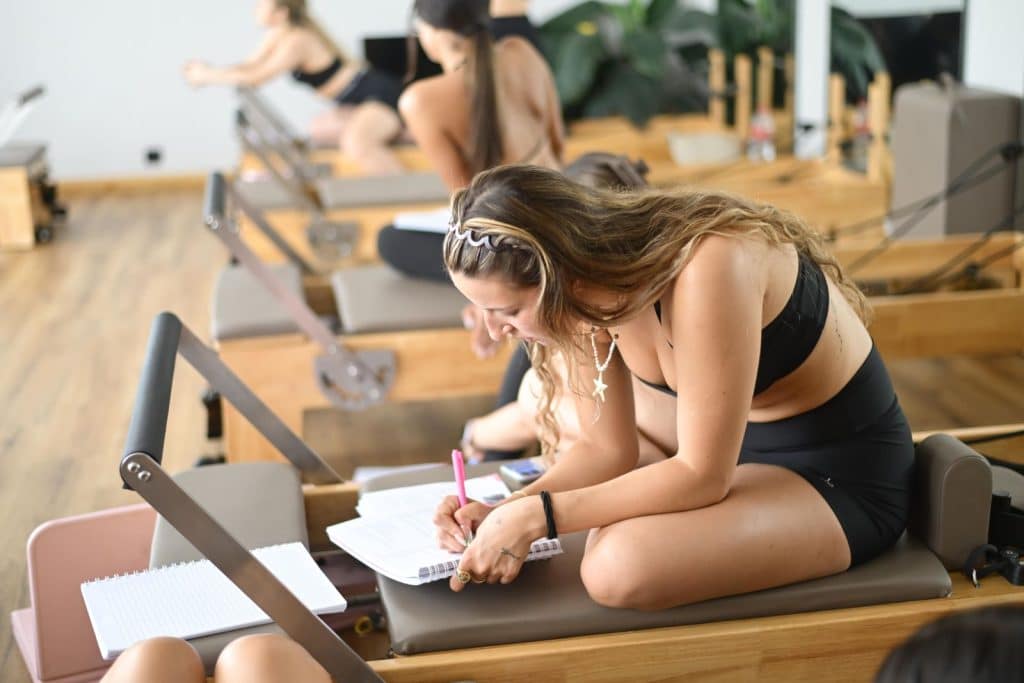
By Chen Leibovich, founder of Go Pilates Academy. Chen has taught Pilates for 10 years, ran two studios of her own, and built an NPCP Verified teacher training program with 700+ certified graduates in 30+ countries.
Every Pilates instructor knows the Sunday-night feeling: notebook open, trying to remember what you taught last week so you don’t repeat it. Planning a good class is a skill, and like any skill it gets faster once you have a structure. This guide gives you the structure we teach our own trainees: how to plan a Pilates class from warm-up to cool-down, how to balance the spine, how to build smooth transitions, and a sample class plan you can teach this week.
The quick answer
- Choose one clear focus for the class (for example, spinal mobility or lateral strength).
- Warm up the breath, the core connection and the spine.
- Move the spine in every direction: flexion, extension, lateral flexion and rotation.
- Build to one or two peak exercises that express your focus.
- Balance the body: front and back, right and left, strength and stretch.
- Plan your transitions so the class flows without long pauses.
- Finish with a cool-down and a moment of integration.
Step 1: Start with one focus, not a list of exercises
The most common planning mistake is starting with exercises you like and hoping they add up to a class. Start instead with a single focus: “rotation and obliques”, “hip mobility”, “posterior chain”, “balance and control”. The focus gives your class a story, makes your cueing more consistent, and makes the class feel intentional to your clients.
Step 2: Use a simple class structure
A reliable structure for a 45–55 minute group class looks like this:
| Phase | Time | Goal |
|---|---|---|
| Centering and warm-up | 5–8 min | Breath, pelvic and ribcage awareness, gentle spinal mobility |
| Spinal articulation | 8–10 min | Move the spine segment by segment, mostly in flexion |
| Strength block | 15–20 min | Abdominals, hips and legs, upper body, built toward your focus |
| Peak | 5–8 min | One or two harder exercises that express the focus |
| Extension and rotation | 5–8 min | Balance all the flexion with back extension and twisting |
| Cool-down | 3–5 min | Stretch, release and a calm finish |
Step 3: Move the spine in every direction
A well-planned Pilates class moves the spine through all of its directions. Most mat repertoire is heavy on flexion (the Hundred, Roll Up, Single Leg Stretch), so check your plan for the other three:
- Flexion: Roll Up, Rolling Like a Ball, the abdominal series.
- Extension: Swan prep, Single Leg Kick, Swimming.
- Lateral flexion: Mermaid, Side Bend, side-lying series.
- Rotation: Spine Twist, Saw, Criss Cross.
If one direction is missing, your class will feel lopsided to your clients even if they can’t say why.
Step 4: Plan the transitions, not just the exercises
Transitions are what separate a list of exercises from a class that flows. Group exercises by body position (supine, side-lying, prone, seated, kneeling, standing) so clients aren’t getting up and down every two minutes. On the reformer, group exercises by spring setting and footbar position to cut down on adjustments. Then write the transition into your plan: “roll to the side, prop on the elbow, into side-lying series”. This flow-first approach is at the heart of The Flow Method™ we teach.
Step 5: Plan levels before you need them
Every group class has mixed levels. For each main exercise, note one modification and one progression in your plan. For example: Roll Up with bent knees or a band (modification), and with arms overhead and slower tempo (progression). You’ll cue with more confidence when the options are already decided.
Get the free 45-minute class plan, with cues, options and the checklist we use to plan every class. Get the free class plan →
A sample 45-minute mat class plan (focus: rotation)
- Centering (5 min): breathing, pelvic tilts, chest lift, supine spine rotation (knees side to side).
- Articulation (8 min): bridging with articulation, Roll Up (or Half Roll Back), Rolling Like a Ball.
- Abdominals (10 min): the Hundred, Single Leg Stretch, Double Leg Stretch, Criss Cross.
- Side-lying (8 min): leg series, then Side Bend prep to work lateral strength.
- Peak (5 min): Spine Twist, then Saw.
- Extension (5 min): Swan prep, Swimming.
- Cool-down (4 min): Mermaid stretch, seated spine stretch, standing roll down to finish.
Common class planning mistakes
- Too many exercises: depth beats variety. Eighteen to twenty-five exercises is plenty for most 50-minute mat classes.
- No extension: clients spend all day in flexion, so build back extension into every class.
- Ignoring the room: plan for the clients you actually have, not the ideal class.
- Rewriting from scratch every week: keep a library of plans and adapt them.
Save hours with a Pilates class planner
Once you have a structure, the slowest part of planning is remembering what you taught and rebuilding it. Our Class Plan Builder app is a Pilates class planner made by instructors for instructors: an exercise library for Mat and equipment, ready-made class plans you can adapt, a drag-and-drop builder, and unlimited saved plans. Build next week’s classes in minutes, not an evening.
Still training to teach? Class planning is built into every track of our online Pilates certification, with a mentor reviewing your plans and watching you teach them.
The 45-Minute Pilates Class Plan
A ready-to-teach mat class with cues and options, plus the structure and checklist we use to plan every class in minutes.
Frequently asked questions
How many exercises should be in a Pilates class?
For a 45–55 minute mat class, around 18–25 exercises works well. On the reformer, fewer exercises with more repetitions and smooth spring changes usually feels better.
How long does it take to plan a Pilates class?
New instructors often spend an hour or more per class. With a clear structure and a library of saved plans, most instructors get it down to 10–15 minutes.
Should I teach the same class plan all week?
Yes, it’s a smart habit. Teaching one plan several times lets you refine your cueing and transitions, and regular clients benefit from repeating and progressing the same work.
Related guides
Chen LeibovichFounder of Go Pilates Academy. A Pilates instructor for 10 years who ran two Pilates studios before founding the academy, she has built an NPCP Verified teacher training program with 700+ certified graduates in 30+ countries.
Turn your love of Pilates into a career you can teach.
Live online with 1:1 mentoring, or in person in a small cohort. Same method, same mentors, same certificate.